
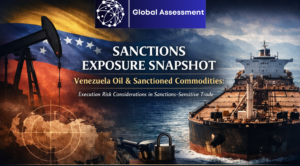
Venezuela Is Not an Oil Story.
It Is an Execution Risk Story.***
Most discussions around Venezuela continue to revolve around production potential, political signaling, or headline investment narratives.
That framing remains incomplete.
From a market and institutional perspective, Venezuela is no longer constrained by the mere absence of crude or capital. Recent political signaling from the United States has indicated a willingness to support large-scale capital deployment aimed at rehabilitating infrastructure and restoring productive capacity. Such statements, while significant, must ultimately be validated through execution, continuity, and durable policy outcomes.
What consistently constrains real-world outcomes is execution under sanctions, volatility, and institutional risk thresholds—both today and across future political cycles in Venezuela and the United States.
This distinction matters.
From permissibility to executability
In sanctions-exposed environments, the central question is rarely whether activity is theoretically permissible. It is whether that activity can be executed, cleared, insured, financed, and defended across institutional systems — and sustained over time.
In the Venezuelan context, transactions frequently fail after appearing viable on paper. Breakdowns typically occur when:
Banks decline to clear payments despite nominal permissibility
Insurers or P&I clubs condition or withdraw coverage
Maritime routing and documentation trigger escalation
Counterparty opacity exceeds internal risk tolerance
Reputational exposure outweighs commercial upside
Political shifts — internal or external — alter risk assumptions, as history has repeatedly shown
These are not edge cases. They are recurring patterns.
Why Venezuela does not behave like a “normal reopening market”
Even under scenarios of political signaling or regulatory relaxation, Venezuela does not transition smoothly into a conventional reopening dynamic.
Execution risk is amplified by:
Sanctions and enforcement volatility
Institutional conservatism among banks and insurers
Interdependency between insurance, financing, and routing
Heightened reputational sensitivity across counterparties
As a result, many initiatives stall not at the legal review stage, but at the point of institutional acceptance.
Sanctions are only part of the constraint
Sanctions exposure is often framed as a binary: allowed or prohibited.
In practice, execution risk is shaped by a broader architecture that includes:
AML and counterparty transparency requirements
Maritime opacity and documentation integrity
Insurance exclusions and post-incident claims risk
Internal governance thresholds and escalation dynamics
A transaction can be technically permissible and still be operationally unexecutable.
That distinction is where capital is most often misallocated.
Control, not volume, shapes outcomes
If Venezuela meaningfully re-enters global energy systems, the decisive factor will not be headline production figures.
It will be determined by who can control:
Execution pathways
Compliance-ready financing
Insurable routing and logistics
Governance frameworks that institutions can defend
In this sense, Venezuela is less a supply story than a test case in risk architecture and institutional alignment.
Why this matters now
Renewed interest in Venezuela is drawing attention from trading houses, insurers, financiers, and service providers.
Institutions with experience in sanctioned environments recognize a consistent reality:
the first point of failure is never production — it is execution.
Understanding where and why transactions break down before capital is committed is no longer optional. It is a governance requirement.
Closing note
At Global Assessment, we approach Venezuela without illusion and without cynicism.
The opportunity is real.
So are the constraints.
Distinguishing between headline optimism and execution reality is what separates defensible exposure from avoidable risk.
Venezuela will not be decided by oil volumes.
It will be decided by execution pathways that institutions can sustain.
Access to our:
Sanctions Exposure Snapshot Venezuela Oil & Sanctioned Commodities
https://globassessment.com/sanctions-exposure-snapshot-venezuela-oil/
—
Global Assessment Corp.
Market Intelligence | Energy | Sanctions | Execution Risk
https://www.linkedin.com/company/globassessment/
Wilfredo Tovar
Director – Global Assessment Corp.
[email protected]
https://www.linkedin.com/in/wilfredotovar