
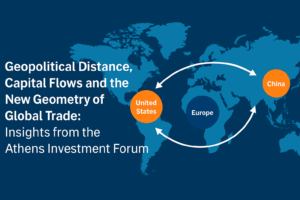
At the Athens Investment Forum, Tiago Devesa (McKinsey Global Institute) presented one of the most compelling analyses of global economic transformation currently underway. His central concept — geopolitical distance — reframes how companies, policymakers and investors should think about global operations.
In this framework, traditional geographical proximity becomes less relevant. Instead, what matters is the degree of strategic alignment between countries: shared rules, security cooperation, technological standards and political-economic values.
One of the most striking findings is that Europe has emerged as the connective hub of global trade. While U.S.–China flows weaken, trade between each of these countries and Europe has grown. Europe’s position in the middle of the geopolitical alignment scale has created a unique structural advantage.
However, trade flows alone do not tell the full story. Capital flows are moving much faster, and they reveal a decisive shift:
Semiconductors FDI has sharply consolidated in the United States.
Future-shaping industries (AI infrastructure, data centers, EVs, advanced manufacturing) now represent 75% of announced global FDI since 2022.
These patterns indicate that companies must reassess where their supply chains, investments and technological capabilities will be most resilient in an era of geopolitical fragmentation.
For businesses operating in North America and Europe, understanding geopolitical distance is no longer optional. It is becoming a core variable in strategic planning, site selection and long-term competitiveness.
This emerging landscape also raises critical opportunities — particularly in data-center infrastructure, energy, semiconductors, and strategic materials — where capital is flowing with unprecedented speed.
Global Assessment Corp. will continue to study and monitor these transitions, helping companies navigate the geometry of global trade and the alignment structures shaping the next decade of economic growth.