
Executive Summary
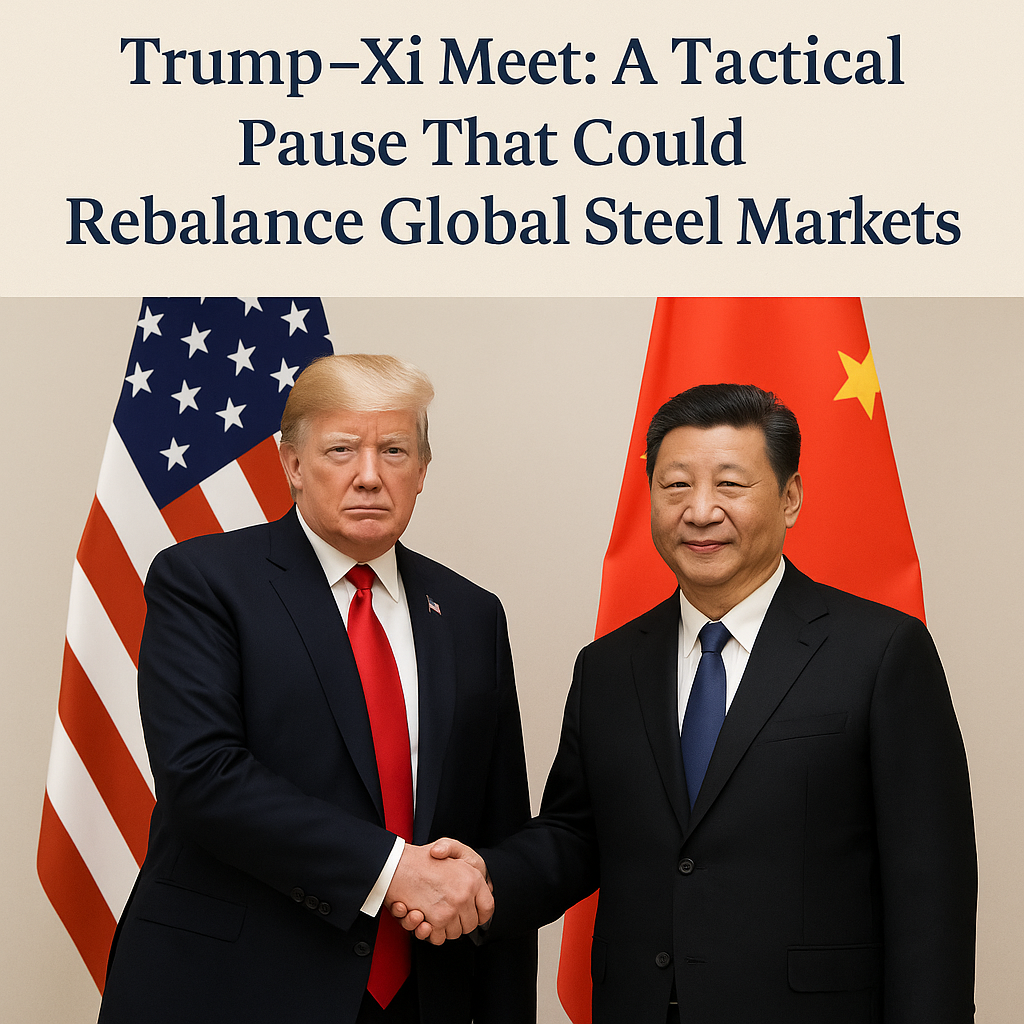
The long-awaited meeting between U.S. President Donald Trump and Chinese President Xi Jinping delivered a rare moment of détente: both sides agreed to pause retaliatory port fees and ease selected tariffs that had strained global logistics and trade flows.
The 12-month suspension, covering an estimated $3.2 billion in annual port charges, immediately alleviates cost pressures in maritime shipping and signals a broader, if fragile, shift in trade dynamics.
For the global steel sector, this development could subtly reshape freight rates, import parity, and price spreads (HRC/CRC) across regions.
1. A Narrow Truce With Wide Economic Ripples
The agreement halts tit-for-tat fees on U.S. and Chinese vessels—measures originally designed to bolster American shipbuilding and reduce China’s maritime dominance. The suspension also temporarily relaxes Chinese counter-fees and follows parallel talks on rare earth exports, farm imports, and technology transfers.
While the truce improves short-term confidence, Section 301 tariffs on a wide range of Chinese goods—including machinery and metals—remain largely intact. This makes the pause a tactical, not structural, adjustment.
2. The Steel Transmission Channel: Freight, Spreads, and Strategy
Steel is among the first industries to react to trade policy signals. The implications of this agreement are unfolding through three key channels:
Freight normalization: Port fee suspensions reduce direct costs and restore capacity allocation flexibility for shipping companies. Lower ocean freight rates can tighten import parity gaps between Asia and North America.
Spread compression: If freight rates retreat and Asian export offers stabilize, HRC/CRC price spreads versus U.S. and Canadian benchmarks could narrow—pressuring domestic margins while creating short-term procurement windows.
Inventory timing: Buyers may advance orders into early 2026 to capture any near-term freight relief, while producers reassess their export strategies under potentially softer logistics costs.
3. Signals for Canada and Latin America
Although the Trump–Xi accord was forged in Asia, its effects extend across the Atlantic.
For Canadian buyers and producers, a moderation in trans-Pacific freight could influence import parity vs. domestic HRC and the relative competitiveness of North American mills.
In Latin America, where logistics costs often represent 20–30 % of landed steel value, even marginal freight declines could open temporary arbitrage opportunities, especially in markets such as Mexico, Brazil, and Chile.
However, given the 12-month horizon, companies should treat this as a tactical window, not a structural shift.
4. Real-Time Data: Turning Headlines into Strategy
At Global Assessment Corp., we monitor these developments through our Global Hot-Rolled Coil (HRC) Price Dataset and Regional Steel Pricing Reports.
These data products allow clients to:
Track monthly HRC and CRC price trends across more than 40 markets;
Quantify freight-adjusted import parity vs. regional benchmarks;
Detect early signals of spread compression following trade or logistics policy shifts.
Our datasets are designed for trade lawyers, procurement teams, and analysts who need actionable, high-frequency insight rather than lagged indicators.
Explore our Global HRC Dataset and Regional Steel Pricing Subscriptions
5. Policy Outlook and Risks
Temporary calm: The pause is valid for one year and could easily unravel amid political tension or renewed tariff escalation.
Uncertain macro backdrop: If global industrial demand weakens, steel prices may fall despite logistical relief.
Regulatory volatility: Export-control decisions on technology, energy, or rare earths can still reshape trade costs and confidence.
In short, this is a breathing space, not a breakthrough.
6. Conclusion: Reading Between the Headlines
Markets often react first to headlines and only later to data.
For decision-makers in steel, logistics, and trade policy, the Trump–Xi agreement is less about symbolism and more about timing—a narrow window to recalibrate strategy before the next policy turn.
At Global Assessment, we translate political moments into quantitative insight.
By combining verified customs data, freight analytics, and regional price benchmarks, we help clients stay ahead of market inflection points—not chase them.
READ OUR ARTICLE IN LINKEDIN AND PLEASE FOLLOW US